Bid Protest Risk Management in Utility Contract Awards
Half of utility protests now succeed, a structural shift that demands earlier risk management.
Winning a utility contract award proves nothing about whether that award will survive. Between the notice of award and the start of performance sits a window, often measured in weeks, where a competitor can file a bid protest and put the entire transaction on hold. In FY 2025, a federal protest oversight body logged 1,688 protests, a 6% decline from FY 2024's 1,803 and roughly 40% below the FY 2016 peak. A shrinking docket reads like good news until you look at what happens inside the cases that remain.
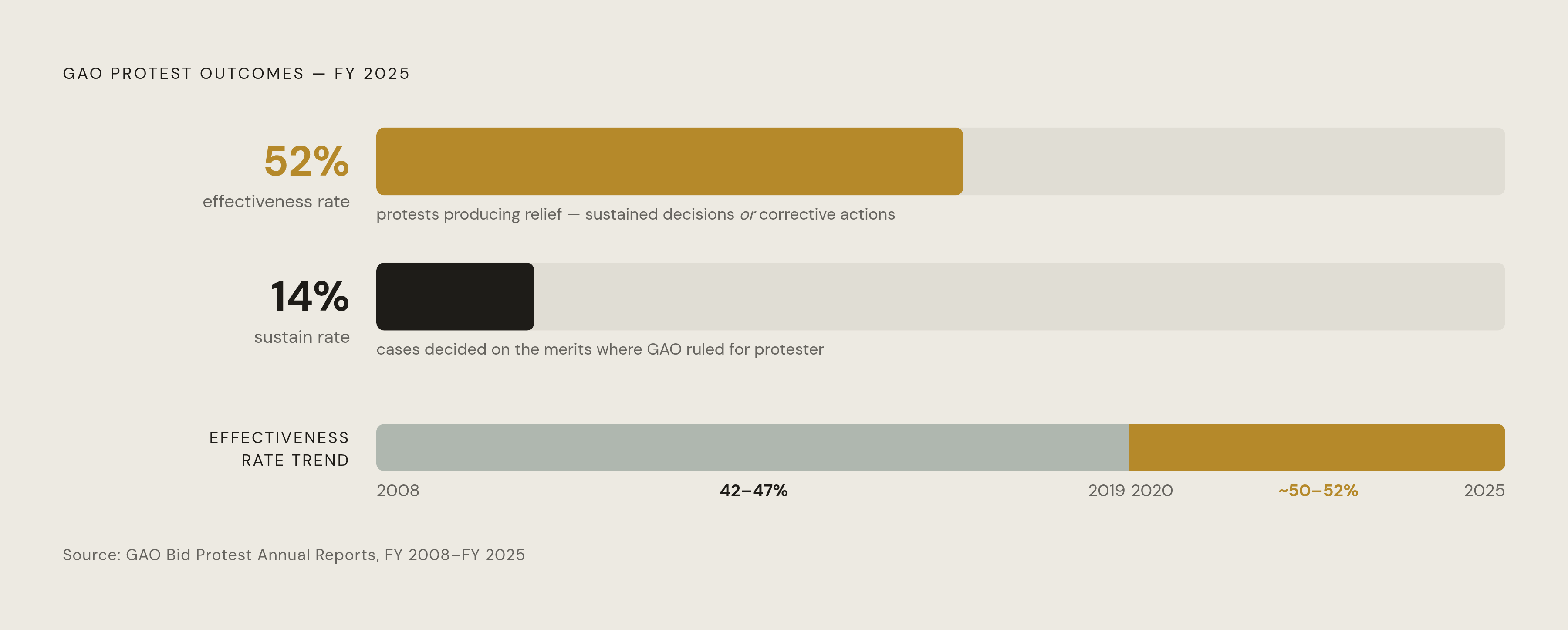
The number most often quoted, the 14% sustain rate, measures only cases GAO decided on the merits. It excludes the much larger share of protests where the agency looked at the filing, recognized a real problem, and fixed it voluntarily before GAO ever ruled. That second category is where the real exposure lives, and a different figure captures it: the effectiveness rate, which measures the share of protests that produced some form of relief for the protester, by sustained decision or by corrective action taken to avoid one. That rate sat at 52% in FY 2025, matching FY 2024, holding steady for a second straight year. This isn't a blip. The effectiveness rate has hovered around 50% since FY 2020, a marked departure from the FY 2008 through FY 2019 span, when it ran between 42% and 47%. Something changed structurally in how agencies respond to protests, and utility contract awards sit squarely inside that shift.
Risk profiles for utility awards across the three protest forums
A federal procurement statute authorizes protests in three places: the procuring agency itself, GAO, and a federal claims court. Each forum plays by different rules, runs on a different clock, and rewards a different strategy. The choice of forum is itself a risk decision, not a formality.
Agency-level protests put the same official who made the award decision in the position of reviewing a complaint about that decision. Some offerors avoid this forum for exactly that reason, and there's no comprehensive public dataset on how agency-level protests resolve, which makes the forum something of a black box compared to GAO's published statistics. It's used less often as a first move.
GAO remains the default. It operates under a 100-day statutory deadline for a final decision, and a timely-filed protest can trigger the automatic CICA stay described later in this piece. In FY 2025, GAO closed 1,737 cases, and 359 of those arose under task-order jurisdiction, a meaningful share given how much utility and infrastructure work moves through task-order vehicles.
A specialized federal claims tribunal deserves more attention than it typically gets in utility-sector planning. Docket patterns and practitioner commentary point to a gradual shift toward COFC as a first-choice forum, likely because COFC can grant injunctive relief and conduct de novo review of certain issues that GAO can only assess under a more deferential standard. For an offeror with deep exposure and a genuinely strong record, COFC's broader remedial power is not a minor detail.
Pre-solicitation and solicitation-stage risks that create protest vulnerability before a proposal is written
Protest risk starts long before an evaluator opens a single proposal. Any apparent impropriety in the solicitation itself, an ambiguous requirement, an unfair evaluation scheme, a term that conflicts with procurement law, has to be protested before the proposal deadline. Missing that window waives the ground. Permanently.
This is the rule that catches offerors who never worked with protest counsel until after they lost. An offeror who spots a defective evaluation criterion during proposal drafting, decides not to rock the boat, submits anyway, and loses, cannot turn around and raise that same defect at GAO or COFC after award. The opportunity closed the moment the proposal deadline passed. That's a hard cutoff, and it punishes exactly the caution that feels reasonable in the moment: don't protest, don't risk annoying the agency, just compete.
Utility solicitations carry a specific version of this problem. Section L and M criteria that describe evaluation factors in vague terms, or that never define what separates "acceptable" from "outstanding" in any qualitative sense, create precisely the conditions GAO has repeatedly found unreasonable once a losing offeror protests after the fact. An agency that omits a required evaluation element, or that leaves "outstanding" undefined beyond a checkbox, is not committing a technicality. It's planting the seed of a sustained protest that may not germinate until months later, after money and staff time have already gone into a losing proposal or a contested award.
The discipline this demands on the agency side is straightforward to state and hard to execute consistently: the solicitation's stated criteria, the evaluation methodology actually applied, and the source selection documentation all need to describe the same evaluation. Any divergence between what Section M promised and what the record shows actually happened is a well-documented route to a sustained protest or a corrective action.
The evaluation errors that most reliably produce a sustained protest or corrective action
FY 2025's leading grounds for sustained protests were unreasonable technical evaluation, unreasonable cost or price evaluation, and, appearing as a leading ground for the first time, unreasonable rejection of proposals. That last category's arrival at the top of the list says something about how agencies are handling competitive ranges and down-selects, not just how they're scoring the finalists.
The emissary LLC decision (B-422388.3, B-422388.4) reads almost like a checklist of what not to do. GAO sustained the protest because the agency assigned an "outstanding" rating where the underlying requirements weren't actually met, failed to evaluate the offeror's phase-in plan on the qualitative basis the solicitation required, accepted a key personnel candidate without any evidence that minimum qualifications were satisfied, and ignored direct contradictions in how the proposal described its own organizational reporting structure. None of these four errors was fatal on its own, necessarily, but GAO found all four in the same record. Agencies that make one of these mistakes are frequently making several at once, because the same rushed or under-resourced evaluation process tends to produce all of them together.
Documentation stands as a fifth failure mode entirely on its own. An agency that cannot show it recorded distinguishing features among competing proposals has effectively reduced its evaluation to a pass/fail screen the solicitation never authorized. An agency doesn't need to make a substantive evaluation error to lose a protest. Failing to write down why one proposal beat another is, by itself, enough.
How the CICA automatic stay works and its deadlines
The CICA stay is one of the most consequential mechanics in the entire protest system, and it's also one of the most frequently misunderstood. It's automatic, but only if the protester hits the right deadline, and the deadlines are not the ones people assume.
GAO has to receive notice of the protest within 10 days of contract award to trigger the stay. But if a required debriefing follows the award, the window to preserve the stay shrinks to 5 days after that debriefing. These are overlapping deadlines that measure from different events, and GAO enforces them strictly. A protest filed on day 9 after award might still be timely under the general rule, yet lose the stay entirely if it came after a debriefing whose 5-day clock had already expired. Whether a protest halts performance or doesn't can come down to which clock the protester's counsel was tracking.
When the stay does take hold, the agency typically has to keep the current contractor performing, by exercising an option period or by standing up a sole-source bridge contract, while GAO works through the case. For a utility that just won a new contract and was counting on the revenue and the operational transition that comes with it, the stay means all of that gets pushed back by however long the protest takes to resolve. And GAO's own numbers show that clock runs the full distance more often than not: the statute gives GAO 100 days to decide any protest filed, and in FY 2025, every final decision came in within that window.
What awardees must do to protect the contract they won
An awardee is not a bystander once a competitor protests. Awardees have the right to intervene in both GAO and COFC protests, and failing to exercise that right carries real consequences. Practitioners and forum rules have made clear that an awardee who sits out the protest loses the ability to protect its own interests in that proceeding, regardless of procedural missteps by other parties. That failure belongs to whoever didn't show up.
Intervention is not just defensive paperwork, either. It can win the case. In Amentum Parsons Logistics Services LLC, Reconsideration (B-422697.14), GAO upheld an intervenor's strategy of challenging the protester's own standing to protest, by pointing to material internal inconsistencies inside the protester's proposal. The protest was dismissed before GAO ever reached the merits of the evaluation. The agency had rated that same proposal "Acceptable," and GAO made clear that rating doesn't insulate a protester if the proposal record itself contains an unresolved conflict on a material requirement. An intervenor can surface that conflict even when the agency never flagged it during its own evaluation.
For utility awardees, this points to a specific and practical review step. Solicitations that use pass/fail or Acceptable/Unacceptable thresholds on things like small business participation, key personnel, or phase-in plans create the clearest opening for exactly this kind of standing challenge. When a protest lands, reviewing the protester's own proposal for inconsistencies across its technical, price, and small business volumes is one of the fastest ways to end the case before the merits ever get argued.
The FY 2026 NDAA incumbent penalty for incumbent offerors in utility markets
Section 875 of the FY 2026 NDAA introduces a financial penalty aimed squarely at a specific incentive problem. It requires the Pentagon to set up procedures that withhold up to 5% of contract payments from incumbent contractors while a GAO bid protest is pending, and those withheld funds are forfeited outright if GAO dismisses the protest for lacking any reasonable legal or factual basis.
The intent is explicit in the statute's design: discourage incumbents from filing a protest merely to exploit the CICA stay described above, which buys them another round of performance, and revenue, while GAO spends up to 100 days working through the case. Instead of the new awardee waiting on the incumbent, the incumbent had been using the protest process itself as a delay tactic, and Section 875 puts a price on doing that without a real legal basis.
Section 875's scope is limited to procurements by one federal military agency, so it doesn't directly reach utility contracts awarded outside that agency's channels. But the logic behind it applies anywhere an incumbent has a strong financial interest in extending its own performance through a filing timed more for its stay effect than its legal merit, and that incentive occurs in utility-adjacent procurement just as readily. Separately, GAO's own data shows the protest process leaning harder on written records rather than live argument. GAO attempted settlement through its alternative dispute resolution process in only 53 cases in FY 2025, down from 76 in FY 2024. Only 3 hearings were held all year, something like 0.5% of total filings. Protests are being decided on the papers far more than they're being argued, which makes the quality of the initial filing, and the completeness of the documentation behind it, the thing that actually decides most cases now.
Building a protest-resilient posture across the full contract lifecycle
Protest risk is not something that appears after an award gets announced. It accumulates from decisions made at the solicitation stage, through proposal preparation, through however the evaluation actually gets conducted, and it doesn't fully resolve until the CICA stay window closes or a protest deadline passes unused. The effectiveness rate hovering around 50% for six straight years is the clearest evidence that this exposure is real at every one of those stages, not concentrated at the end.
At the pre-solicitation stage, agencies need to write evaluation criteria specific enough to support real qualitative differentiation between proposals, and offerors need to bring in protest counsel while reviewing the solicitation itself, not after they've already lost the award. During proposal preparation, keeping the technical volume, the price volume, and the small business volume consistent with each other isn't just good practice, it's standing protection: Amentum shows GAO will read across those volumes looking for a material inconsistency even when the agency's own evaluators never caught it.
At the evaluation stage, documentation discipline is the one defense that holds up across every forum and every kind of challenge. The record has to show that Section L and M criteria were actually applied as written, that every rating traces back to a specific, stated finding, and that proposals judged against each other were actually treated on comparable terms. Agencies that keep that record intact rarely lose protests on the merits. Agencies that don't are the ones filling GAO's docket, year after year, regardless of how many total protests get filed.
Sources
- Understanding Bid Protest Deadlines: A Practical Guide for Government Contractors | Insights | Holland & Knight
- As GAO Reopens Post-Shutdown, Contract Awardees Should Leverage a Powerful Early Tactic to Defeat Bid Protests | Insights | Mayer Brown
- Government Contract Bid Protests Before Agencies | Administrative Conference of the United States
- U.S. GAO - Bid Protests: Key Features and Trends
- americanbar.org
- swlaw.com
- infrainsightblog.com
- governmentcontracts.foxrothschild.com